


What Is Letterpress Printing and Why Does It Matter for Your Wedding Invitations?
Updated: Jun 12

Tom inking 1916 Chandler & Price | Photo credit: Jabberpics
There is a sound a letterpress makes that you don't forget. A rhythmic, deliberate thud as each sheet feeds through by hand. In a world of instant everything, it stops you. It asks you to slow down. That sound is coming from a 1916 Chandler and Price in our Savannah studio, and it has been pressing wedding invitations, business cards and everything in between for over a century. It has pressed things we'll never know about. What we do know is it hasn't stopped.
If you've been drawn to letterpress invitations without fully understanding why, this is for you.
What letterpress printing actually is
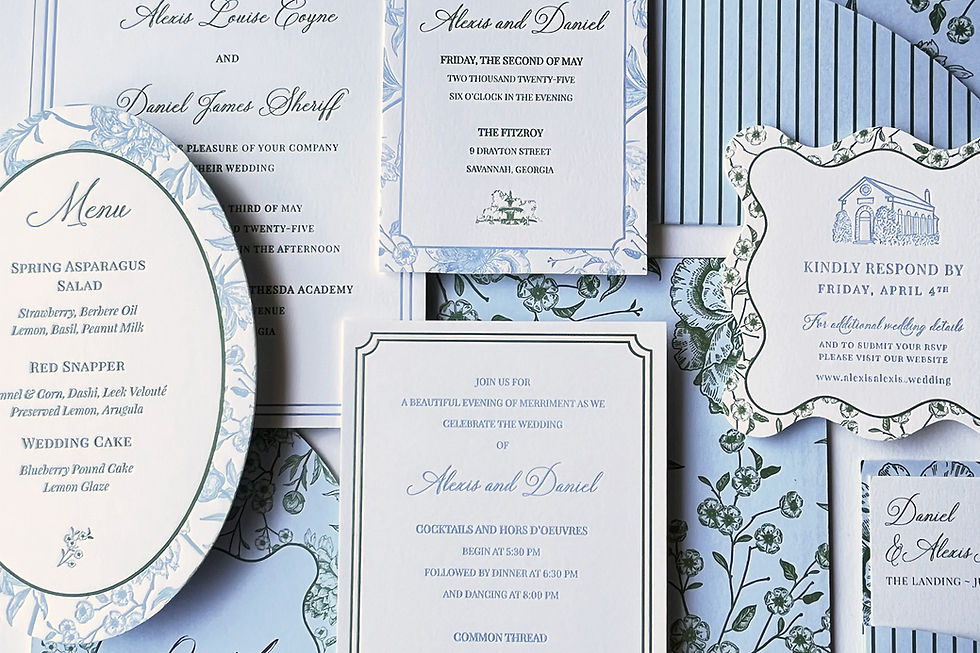
Letterpress is one of the oldest forms of printing still in use today. A metal or polymer plate, carrying your design in reverse, is inked and pressed directly into the paper under significant pressure. The result is a physical impression you can see and feel. Run your finger across a letterpress invitation and you'll find the design set into the surface of the paper rather than sitting on top of it.
That impression is what makes letterpress different from every other printing method. Digital printing sits on the surface. Letterpress goes in. The paper it presses into matters just as much as the press itself. Cotton paper gives. It holds. It doesn't feel like something you'd throw away.
The press that does the work
Our Chandler and Price was built in 1916. It has been running longer than anyone currently alive and it shows no signs of stopping. There is something quietly remarkable about the fact that a machine made over a hundred years ago is still pressing wedding invitations in a sun-warmed Savannah studio in 2026.
Tom has never met a press he didn't want to bring home. The 1916 Chandler and Price is just the one that stayed.

How Tom works
Every job starts with the paper then the press. Tom cuts all the paper by hand then proceeds to clean the press to start a fresh color. Then comes the ink.
Ink mixing is where the job either starts right or doesn't. Tom mixes by eye and by instinct, matching to the color specified until it's exact. If it isn't exact he cleans the press and starts again. Sometimes it's right on the first pass. Sometimes it takes several. He has opinions about this process that are best not repeated in print.
Once the color is right comes registration, the alignment of the plate to the paper so that every impression lands exactly where it should. Tom has an exceptionally good eye for this. Something slightly off that most people would miss he catches immediately. The plate gets adjusted. The pressure gets set. Then he checks it again.
Then he hand feeds. Every sheet. One at a time.
Some colors get two passes through the press to deepen them. Every sheet that comes off is examined. Tom looks at each one as it comes through. That attention is not a policy. It's just how he works.
Ask Tom which part is the real craft. He'll tell you he loves antique presses.
That says everything.
What this means for your invitations
When your suite arrives it will carry the evidence of all of this. An impression set into cotton paper by a machine that has been doing this since before your grandparents were born, run by someone who checked every single sheet before it left the press.
That's not something you can replicate digitally. It's not something you can rush. It's the reason letterpress invitations feel different in your hands from the moment you open the envelope and the reason guests keep them long after the wedding is over.
Ready to see what's possible?
Every suite at Lolli Pop Letterpress starts with a conversation. Tell us about your wedding and we'll show you what the press can do.
Ash
Lolli P


Comments